
AI Model Comparisons
Explore leading AI models through structured evaluation criteria, benchmark evidence and practical use cases. Understand the differences that matter when selecting a model for your needs.
Independent analysis. Transparent criteria. Informed technology decisions.
Compare Models Beyond the Headlines
AI models differ in capabilities, limitations, deployment options and suitability for particular tasks. A useful comparison considers the full context rather than relying on a single score.

Leading AI Models
Explore model families and their documented capabilities, supported inputs and outputs, access options and intended applications. Availability and features vary by version.
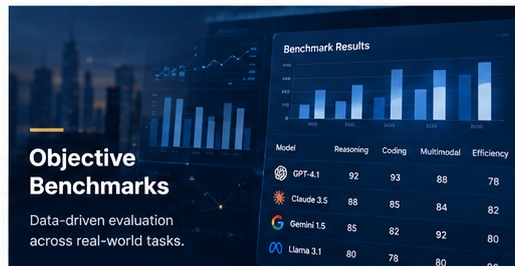
Benchmarks & Capabilities
Examine reasoning, coding, instruction following, multimodal capabilities and other relevant dimensions using suitable evaluation methods and clearly identified evidence.

Use-Case Comparisons
Assess how model characteristics align with business workflows, research tasks, software development, knowledge work and multimodal applications.

Expert Insights
Put evaluation findings into context by considering task requirements, reliability, operational constraints and the limitations of available evidence.
What Makes a Meaningful Comparison?
Performance depends on the task, evaluation method, model version, prompting approach and operating conditions. Comparisons are most useful when these factors are documented and interpreted carefully.
- Clearly defined tasks and evaluation criteria.
- Identified model versions and relevant testing conditions.
- Comparable evidence with documented limitations.
- Distinction between benchmark results and real-world performance.
- Attention to reliability, safety and practical constraints.
Dimensions That Matter
A balanced assessment considers technical capability alongside usability, risk and the requirements of the intended deployment.
Reasoning & Problem Solving
Examine performance on well-defined analytical, reasoning and multi-step tasks relevant to the intended use.
Language & Content
Consider instruction following, summarization, writing quality, information synthesis and language requirements.
Coding & Technical Tasks
Assess software development support, code interpretation, debugging and performance on relevant technical tasks.
Multimodal Capabilities
Review supported text, image, audio or video workflows and the constraints associated with each model version.
Cost & Latency
Consider applicable pricing, throughput, response time, usage limits and the cost of completing a real task.
Safety & Deployment
Examine privacy, security, governance, access controls, reliability and deployment requirements.
Match Model Capabilities to Real-World Needs
The most appropriate model depends on what needs to be achieved, the consequences of errors, the information involved and the operational environment.
Look Beyond the Headline Price
Selecting an AI model involves more than comparing published token prices. The cost of a solution also depends on workload, input and output volume, latency requirements, integration, oversight and the need to verify results.
- Pricing and usage limits for the relevant model version.
- Context capacity and typical input/output requirements.
- Latency, throughput and service availability.
- Integration, monitoring and human-review costs.
- Performance on representative tasks, not just generic tests.

Understand the Direction of AI Innovation
The AI landscape continues to evolve across model capabilities, deployment approaches, governance expectations and market competition. Effective evaluation requires attention to both technical progress and the wider implications for organizations and the digital economy.
- Model Capabilities
- Open & Proprietary Ecosystems
- AI Governance
- Enterprise Adoption
- Efficiency & Infrastructure
Make Better-Informed AI Decisions
Use a structured approach to understand model capabilities, evaluate trade-offs and identify the questions that matter for your organization or research.