
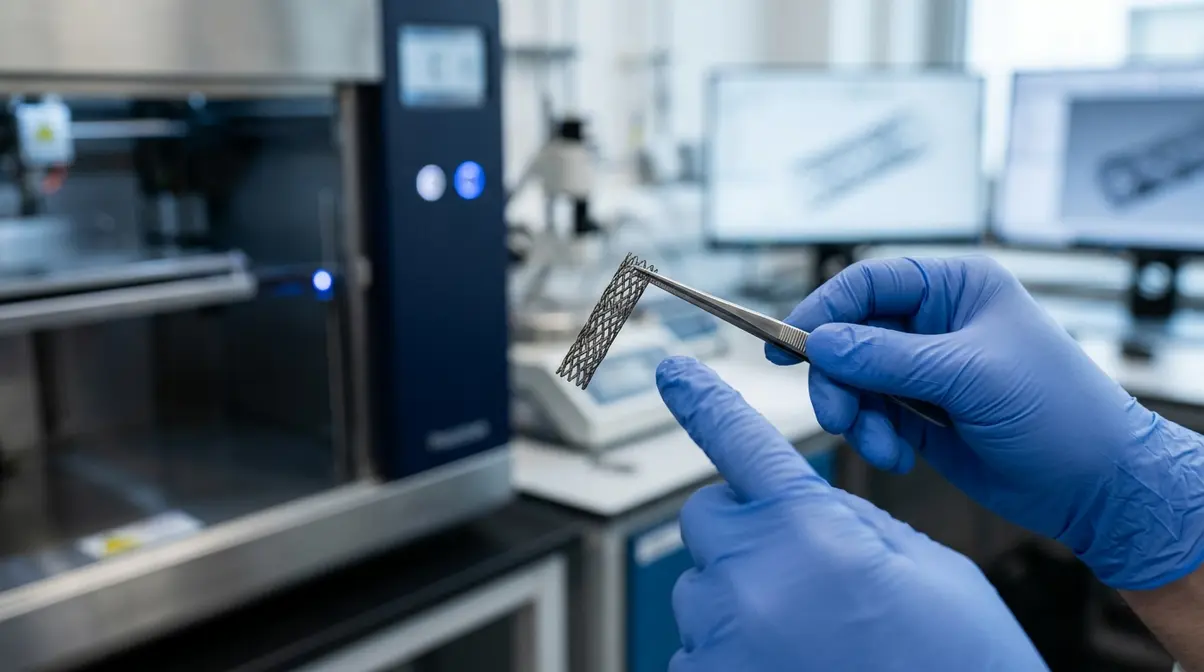
<p>An international research team led by the IMDEA Materials Institute and the Universidad Politécnica de Madrid (UPM) has successfully developed 3D-printed vascular stents using nitinol. The new design demonstrates enhanced mechanical durability, allowing the devices to be compressed to half their original diameter while maintaining the ability to regain more than 90% of their intended shape.</p><p>These braided structures represent a significant technical development in the production of medical implants through additive manufacturing. By utilizing the unique properties of nitinol—a nickel-titanium alloy known for its superelasticity and shape-memory characteristics—researchers have created devices that can withstand the physical rigors of vascular environments without breaking.</p><p>The study highlights the potential of 3D printing to create complex, flexible medical components that require precise geometric control. As the medical field continues to integrate advanced manufacturing techniques, such developments in material resilience and structural integrity serve to improve the reliability of vascular implants. Further details on these findings were reported by the 3D Printing Industry.</p>
Source: 3D Printing Industry
Original article: https://3dprintingindustry.com/news/woven-in-metal-imdea-and-upm-3d-print-stents-that-bend-without-breaking-255810/?utm_source=rss&utm_medium=rss&utm_campaign=woven-in-metal-imdea-and-upm-3d-print-stents-that-bend-without-breaking
Leave a Reply