
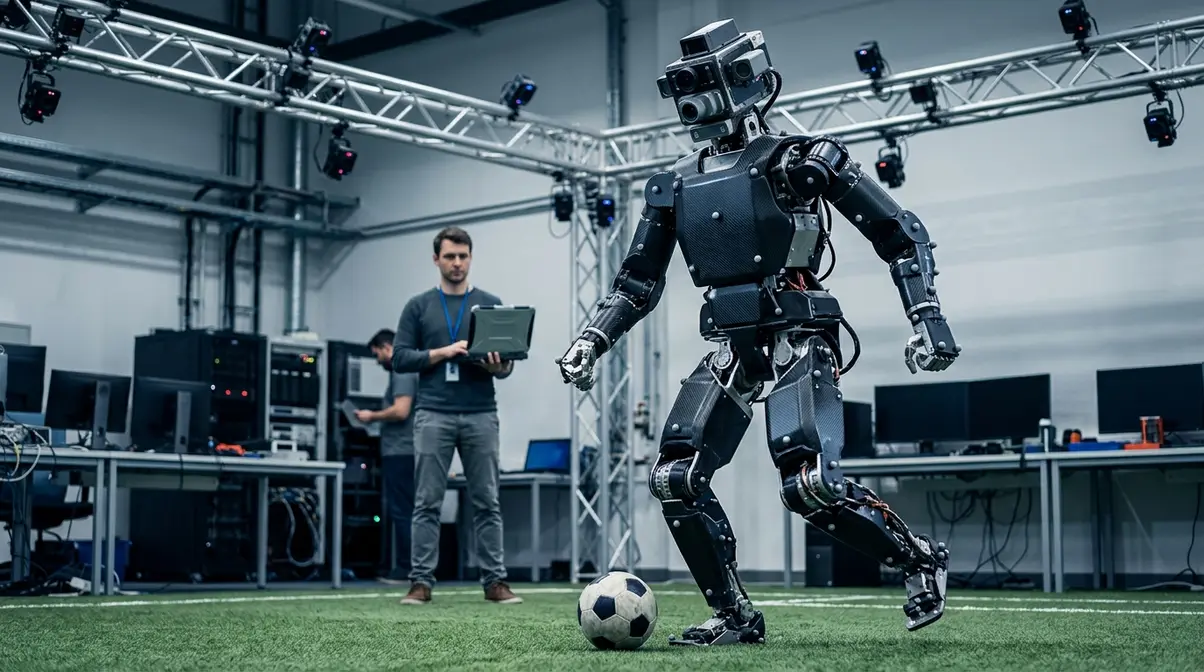
A recently released white paper examines the engineering challenges associated with achieving professional athletic motion in humanoid robots. The document, intended for roboticists and control engineers, focuses on the decoupling of motion planning and motion tracking as a method to maintain athletic style while ensuring reliable task performance.
One of the primary difficulties in humanoid ball-sports robotics is the trade-off between replicating the fluid motion style of a professional athlete and maintaining high-level performance accuracy. To address this, the paper advocates for the separation of a high-level motion planner from a low-level tracker. This approach allows developers to reconstruct, retarget, and physically correct motion data—extracted from broadcast videos or motion-capture recordings—into reference motions that a humanoid robot can track safely.
The research further explores the 'sim-to-real' transition, where robots often encounter compounding tracking errors. To mitigate these issues, the authors propose training trackers on randomized execution speeds, combined with a learned motion-speed adapter integrated into the high-level planner. According to the document, this framework improves robustness when moving from a virtual environment to physical hardware.
This adaptive approach has been validated across two humanoid platforms. The research highlights the effectiveness of the system in scenarios such as full-size, in-the-wild serving, which was performed without the aid of external motion-capture infrastructure. The white paper provides a comprehensive overview of these control strategies and the necessity of adaptive, speed-aware systems for real-world robotics deployment.
Source: content.knowledgehub.wiley.com
Original article: https://content.knowledgehub.wiley.com/learning-to-play-like-a-pro-adaptive-motion-planning-and-tracking-for-humanoid-robots/
Leave a Reply