
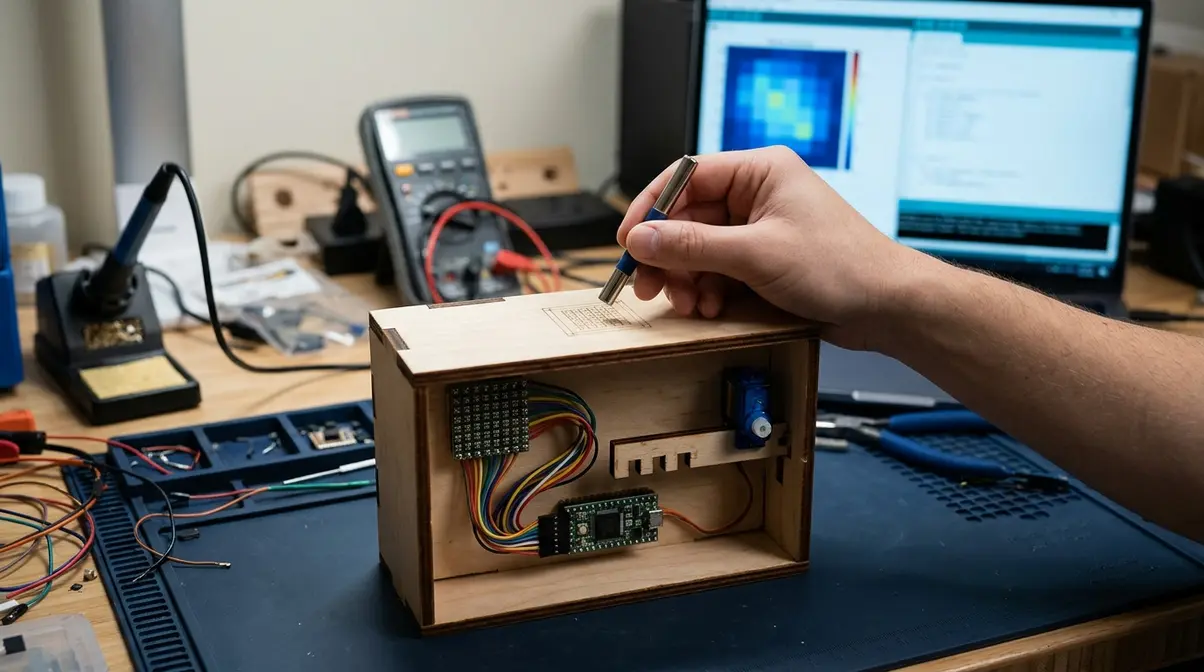
A recent project has explored the use of magnetic imaging technology to create a sophisticated, concealed lock mechanism. By utilizing an 8-by-8 grid of Hall-effect sensors—specifically a magnetic imaging tile designed by SparkFun—a developer was able to create a system that unlocks only when a specific, programmable magnetic gesture is performed over the sensor area.
Technology and implementation
The system relies on the tile’s ability to detect both the polarity and magnitude of a magnetic field at a high sampling rate, allowing it to capture the motion of a handheld magnet. A Teensy 4.1 microcontroller processes the input data from the SPI interface. To create the gesture-recognition capability, custom support libraries were developed to record specific motions and save them to nonvolatile storage, comparing subsequent inputs against a selectable threshold for authentication.
The physical locking mechanism consists of a wooden box modified to include a servo motor and a notched beam, which acts as the physical catch. To navigate the small sensing area—approximately 3 centimeters square—the creator used a visual reference pattern on the exterior of the box, ensuring that repeatable gestures could be accurately registered by the sensors hidden beneath the surface.
Security considerations
One primary advantage of this approach is the potential for improved physical obfuscation. Unlike traditional RFID systems, which emit signals that can be detected externally, a magnetic sensor system can be shielded behind materials like copper sheeting, which functions as a Faraday cage. This prevents unauthorized detection of the lock’s location using electromagnetic field meters.
However, the current iteration presents practical challenges for real-world deployment. The system lacks a fail-safe mechanism, meaning that if the internal battery pack were to deplete while the box is locked, the enclosure would be difficult to open without damage. Future improvements to such designs could include hidden inductive charging coils to maintain power levels. This proof-of-concept highlights how affordable sensor grids and microcontrollers are enabling more creative, DIY approaches to physical security and access control.
Source: IEEE Spectrum
Original article: https://spectrum.ieee.org/magnetic